-

-
>News
-
>General News

Spinal Muscular Atrophy (SMA): Why SMN1 Testing Matters
Someone may look completely healthy and still carry an SMA associated genetic change. That’s one reason genetic testing can play an important role in SMA carrier screening and risk assessment.
· What is SMA?
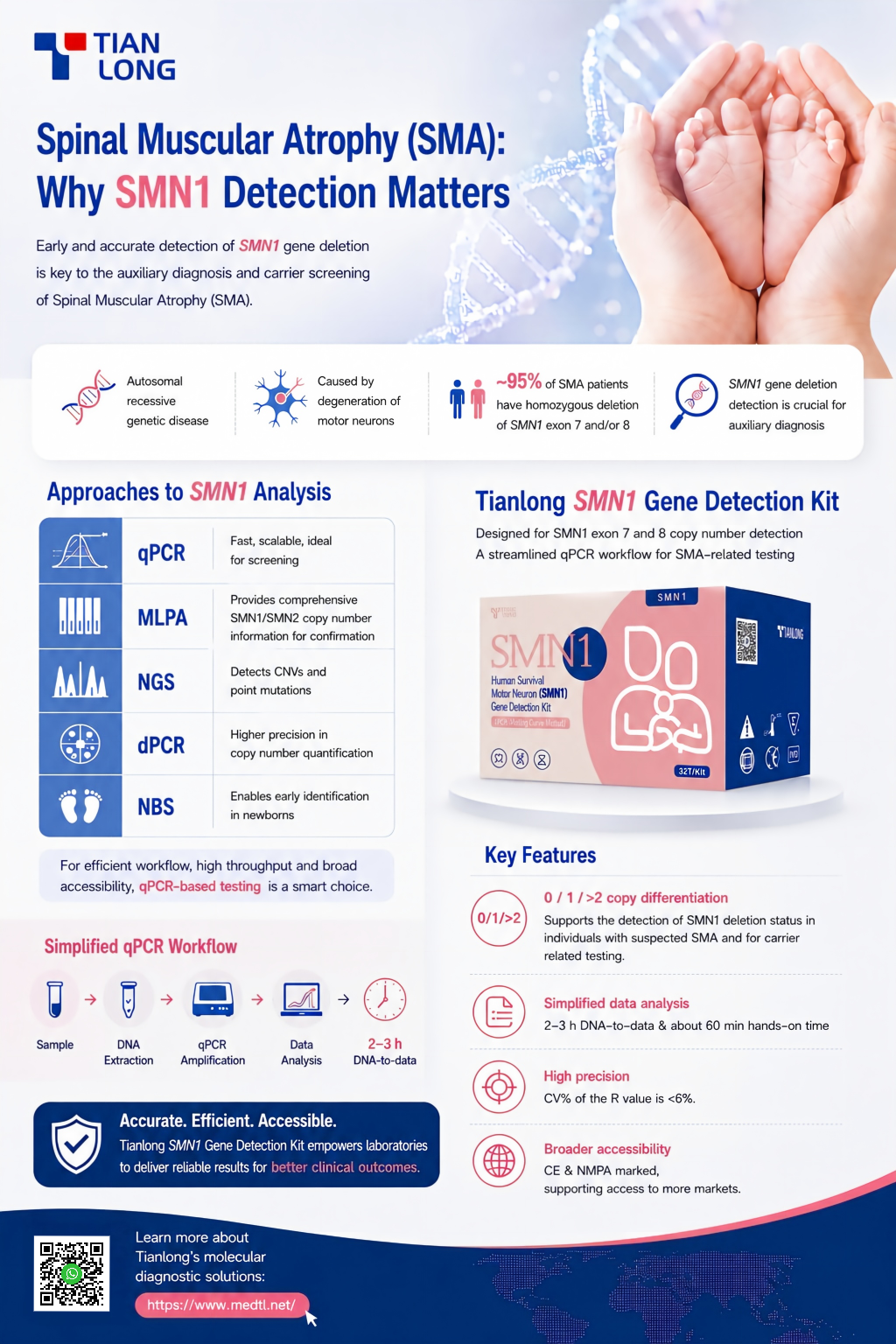
Spinal Muscular Atrophy (SMA) is an autosomal recessive genetic disorder characterized by the progressive loss of motor neurons. As motor neurons are affected, patients can develop:
· Muscle weakness
· Muscle atrophy
· Loss of motor function
· In severe cases, difficulties with swallowing and breathing
SMA can present from infancy to adulthood, while SMA carriers are typically asymptomatic.
· Why is SMN1 important?
At the genetic level, SMA is primarily associated with abnormalities in the survival motor neuron (SMN) gene. The human genome contains two highly homologous genes, SMN1 and SMN2. SMN1 is the primary gene associated with SMA.
Importantly, approximately 95% of SMA patients show homozygous deletion of exon 7 and/or exon 8 of the SMN1 gene. This makes the detection of SMN1 gene deletion an important component of the auxiliary diagnosis of SMA.
· From genetic insight to practical testing
Different technologies can be used for SMN1 analysis, including:
qPCR | MLPA | NGS | dPCR | Newborn Screening
Different approaches have different applications and considerations. For laboratories looking for an efficient approach to SMN1 deletion detection, qPCR-based testing offers advantages in workflow simplicity, throughput and accessibility. This is where Tianlong’s solution comes in.
· Tianlong Human SMN1 Gene Detection Kit
Tianlong's Human Survival Motor Neuron 1 (SMN1) Gene Detection Kit is designed to detect the copy numbers of SMN1 exons 7 and 8, supporting the auxiliary diagnosis of SMA and carrier-related testing.
Key features:
· 0 / 1 / >2 copy differentiation
Designed to support SMN1 copy-number assessment in SMA-related testing and carrier screening.
· Simplified data analysis
2–3 h DNA-to-result & about 60 min hands-on time
· High precision
CV% of the R value <6%.
· Broader accessibility
CE & NMPA Marked for broader market accessibility.
(This post is intended for educational and informational purposes only and should not be considered medical advice. Testing and clinical decisions should be made in consultation with qualified healthcare professionals.)
#Tianlong #SMA #SpinalMuscularAtrophy #SMN1 #MolecularDiagnostics #GeneticTesting #PCR #qPCR #IVD #ClinicalDiagnostics #LaboratoryMedicine #GeneticDisease
Did you know? Even healthy people with no family history of SMA can be carriers. How familiar are you with SMA carrier screening?
A. New to me
B. Heard of it, but not tested
C. I’m familiar with it