
-

-
>News
-
>General News

From a Firefly’s Glow to New Possibilities in Hygiene Monitoring
On a summer night, a firefly lights up the darkness with a faint glow from its tail.
Nearly eight decades ago, scientists began exploring the chemical mechanisms behind this natural phenomenon. Today, ATP bioluminescence technology, developed from the principles of biological light emission, is used in applications ranging from food processing to healthcare hygiene monitoring, helping assess surface cleanliness rapidly.
The story of this technology began with a scientific discovery about light and energy.
1. A Discovery in 1947: From Firefly Bioluminescence to ATP Testing
In 1947, biochemist William McElroy investigated the mechanism behind firefly bioluminescence. He found that ATP (adenosine triphosphate) plays a role in the light-producing reaction. This discovery opened the door to further research: if the bioluminescence reaction could be used to detect ATP, light emission could potentially serve as an analytical tool.
In 1952, Bernard Strehler and John R. Totter further developed the application of the firefly luminescence system for quantitative ATP measurement, exploring how light signals could be used to analyze biological samples.
From that point on, the firefly’s glow became more than a fascinating natural phenomenon. It also became a tool for investigating biological detection methods. As the technology advanced, ATP bioluminescence gradually found its way into practical applications.
2. From the Laboratory to the Production Line: Why Does Industry Need ATP Testing?
The development from firefly bioluminescence to quantitative ATP measurement gave scientists a way to detect ATP through light signals. But for a laboratory technique to become useful in real-world production environments, a more practical question had to be answered: What can measuring ATP actually help us understand?
Traditional microbiological testing methods, such as plate counting, involve inoculating samples onto culture media, incubating them under controlled conditions, and counting the resulting colonies. Although culture-based methods are widely used as reference methods for microbiological assessment, they have a significant limitation in fast-paced food production environments: incubation may take hours or even days. By the time results become available, production may already have continued for many cycles.
For continuously operating production lines, waiting for test results can mean missing an opportunity to adjust cleaning procedures promptly.
ATP bioluminescence testing offers another approach. Using a portable ATP hygiene monitoring system, personnel can collect samples and perform tests directly at the point of use. The process typically takes only seconds to minutes, without waiting for microbial colonies to grow or sending every sample back to the laboratory.
When results become available more quickly, hygiene monitoring can move beyond retrospective verification and become a more responsive part of ongoing hygiene management.
3. One Hygiene Goal, Different Testing Approaches
Both ATP testing and microbiological culture methods can contribute to hygiene management, but they measure different things.
Think of hygiene management as an ongoing inspection process. ATP testing is like a rapid on-site check, helping personnel identify areas that may require attention. Microbiological culture methods, through cultivation, enumeration, or identification, can provide further information about the presence, quantity, and types of microorganisms.
However, rapid results do not mean ATP testing can identify every hygiene risk.
ATP-related signals may originate from microorganisms, but they can also come from other biological materials, such as food residues. Therefore, ATP readings cannot be directly equated with microbial counts, nor can ATP testing alone determine whether a specific pathogen is present.
As reported by Sanna et al. (2018) in a study on cleaning verification in operating theatres, ATP bioluminescence testing cannot replace culture-based methods, but it can serve as an effective tool for evaluating cleaning performance. By providing rapid feedback, it can help increase personnel awareness and enable timely corrective action.
The shared goal of hygiene management does not mean that every situation requires the same testing method.
4. Different Approaches to Bioluminescence Detection
At this point, the development of ATP testing may seem to follow a straightforward path. Yet scientific progress rarely stops at a single method. As researchers explored different ways to capture biological signals in samples, new approaches to ATP-related testing emerged.
Researchers at Japan-based Kikkoman Corporation explored an important consideration in long-duration fermentation processes. When microbial metabolism is highly active, ATP levels may be relatively high. As fermentation progresses and nutrients become depleted, ATP can be rapidly converted into ADP (adenosine diphosphate) and AMP (adenosine monophosphate).
By introducing two additional enzymes into the detection system—pyruvate kinase (PK) and pyruvate phosphate dikinase (PPDK)—ADP and AMP can be converted back into ATP and then detected together.
At the fundamental level, the A3 method remains based on the same firefly bioluminescence framework. It still relies on the core luciferase–luciferin–ATP reaction. The difference is that the A3 method introduces additional enzymatic cycling steps into the reaction system, effectively acting as a signal amplification mechanism by bringing ATP-related degradation products into the detection process.
However, this does not mean the A3 method can detect every type of organic residue, nor does a higher signal necessarily indicate poorer cleaning performance. What changes is the detection system’s approach to capturing different adenylates—not the central role of ATP in the bioluminescence reaction.
5. ATP and A3 Testing: A Shared Principle, Different Detection Pathways
If the development of ATP bioluminescence testing were a tree, the original discovery of bioluminescence would be its roots, portable ATP instruments would represent the technology’s expansion into production environments, and the A3 method would be another pathway developed from the same underlying principle.
Both approaches are based on bioluminescence, but they differ in how they process adenylates in a sample.
In certain samples, where ADP and AMP account for a meaningful proportion of the total adenylates, the A3 method may produce a stronger signal than conventional ATP-only testing. The actual difference, however, depends on multiple factors, including sample composition, reaction chemistry, and instrument performance.
In routine cleaning verification, an effective cleaning procedure should remove most organic residues. Under these conditions, RLU readings from surfaces that meet the relevant acceptance criteria should decrease substantially, whether ATP or A3 testing is used.
The difference between the two methods is therefore more about their signal-enhancement strategies than their overall purpose.
It is also important to understand what RLU represents. RLU, or relative light units, is a measure of the relative light signal generated by a detection system. It is not a direct measurement of ATP concentration or microbial count.
Because different detection systems may use different reaction mechanisms, reagents, and instruments, their RLU values are not necessarily directly comparable. A higher reading on one instrument does not, by itself, demonstrate superior detection capability or indicate a poorer hygiene outcome.
In practical applications, acceptance thresholds should be established and applied using methods that have been appropriately validated for the specific system and intended use.
Neither ATP nor A3 testing can independently identify specific microorganisms or be treated as equivalent to microbiological culture results. Regardless of the method selected, results should be interpreted in the context of the application and the relevant validated criteria.
Ultimately, the value of a hygiene monitoring method lies not in producing a higher reading, but in providing information that helps answer the practical questions at hand.
6. In Closing: The Significance of a Small Light
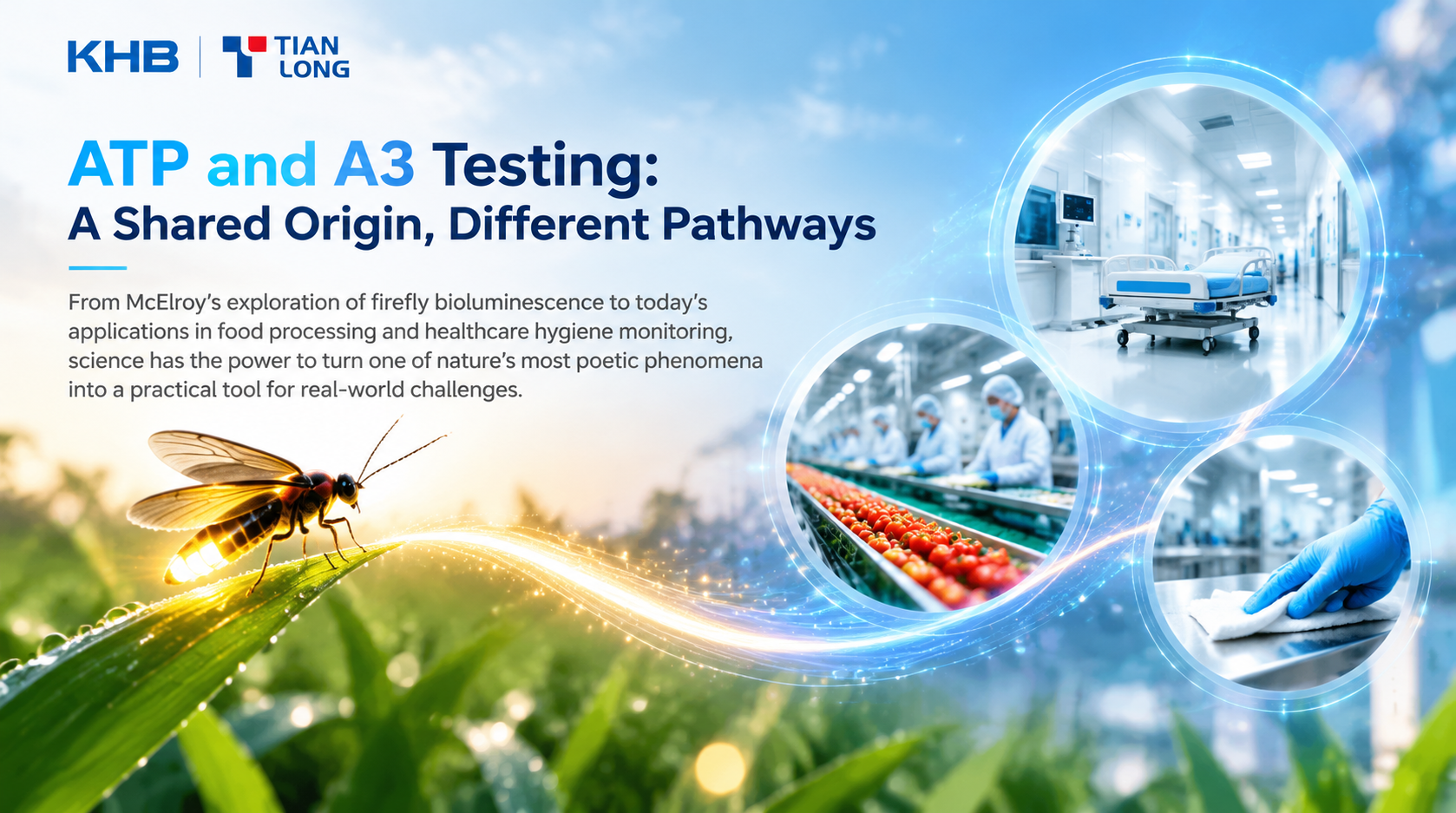
From McElroy’s exploration of firefly bioluminescence to today’s applications in food processing and healthcare hygiene monitoring, one of the remarkable aspects of science is its ability to transform a beautiful natural phenomenon into a practical tool for solving real-world problems.
The firefly glowing in a summer field could never have known that its faint light would inspire scientists to investigate the mechanisms of bioluminescence and set in motion a journey of technological development.
Built on the same fundamental light-producing principle, researchers have continued to explore different ways of detecting and interpreting biological signals.
In hygiene monitoring, what matters is not simply the number displayed on a screen. It is understanding where that number comes from, what it can tell us, and how the information can support practical decisions.
The next time you see an RLU reading on an ATP hygiene monitoring system, consider the science behind it: a discovery spanning nearly eight decades, translated into a small but meaningful signal in just seconds.
References
1. McElroy WD (1947). The energy source for bioluminescence in an isolated system. Proceedings of the National Academy of Sciences, 33:342–345.
2. Strehler BL, Totter JR (1952). Firefly luminescence in the study of energy transfer mechanism. Archives of Biochemistry and Biophysics, 40:28–41.
3. Sanna T et al. (2018). ATP bioluminescence assay for evaluating cleaning practices in operating theatres. BMC Infectious Diseases.
4. Wang Zhuo (2004). Application and prospects of ATP bioluminescence microbial detection in food hygiene monitoring. Chinese Journal of Food Hygiene.
5. Cui Chaoli et al. (2023). Comparison of ATP bioluminescence and rapid coliform test paper methods for evaluating the disinfection efficacy of catering utensils. Chinese Journal of Disinfection.
6. Bakke M et al. (2019). Evaluation of total adenylate test for cleaning verification. Journal of Infection and Public Health.

